
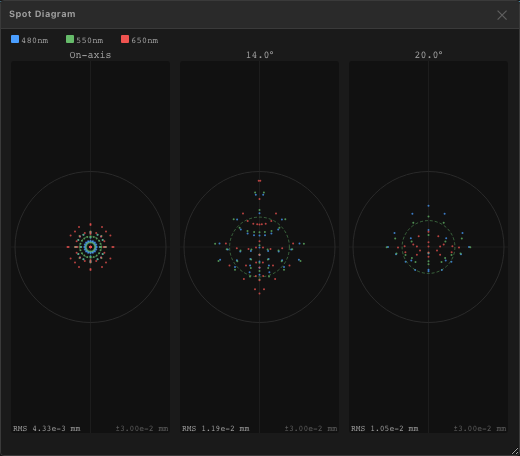
The Cooke Triplet is the workhorse of photographic lens design: three elements, two glasses, and a well-corrected image for its simplicity. This f/5 configuration uses N-SK16 crown elements flanking an F2 flint, covering a 40° diagonal field. A good starting point for understanding aberration balancing and glass choice.


Opens directly in Trefoila.
Requires an active license.

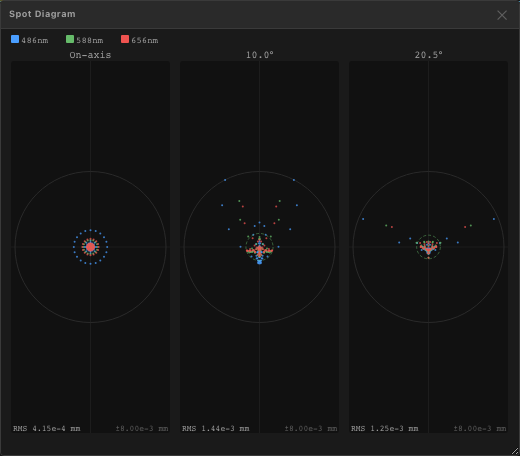
The Tessar is a four-element design derived from the triplet by splitting the rear element into a cemented doublet, giving a compact, sharp lens with excellent correction across a wide field and the formula behind countless camera lenses from the early 20th century onward.


Opens directly in Trefoila.
Requires an active license.

The Double Gauss is the foundation of most fast normal photographic lenses. Its symmetric arrangement of two Gauss telescope halves produces exceptional correction of coma and lateral colour, making it the go-to starting point for wide-aperture designs. This f/5 example covers a 28° full field at 100mm EFL.


Opens directly in Trefoila.
Requires an active license.

The Petzval lens dates to 1840 and remains one of the fastest corrected designs ever devised. Its characteristic field curvature and swirly off-axis bokeh are prized in portrait photography. This f/1.4 example at 50mm EFL uses N-LAK12 and SF4 to push on-axis performance while retaining the classic character.


Opens directly in Trefoila.
Requires an active license.

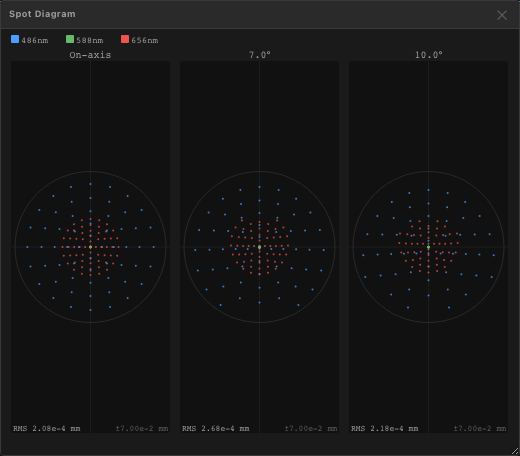
The Heliar is a five-element symmetric design, essentially a Cooke Triplet with each outer element replaced by a cemented doublet. The additional degrees of freedom allow excellent correction of field curvature and astigmatism across a wide angle. This compact f/5 example has an ~8mm EFL suited to miniature camera formats.


Opens directly in Trefoila.
Requires an active license.

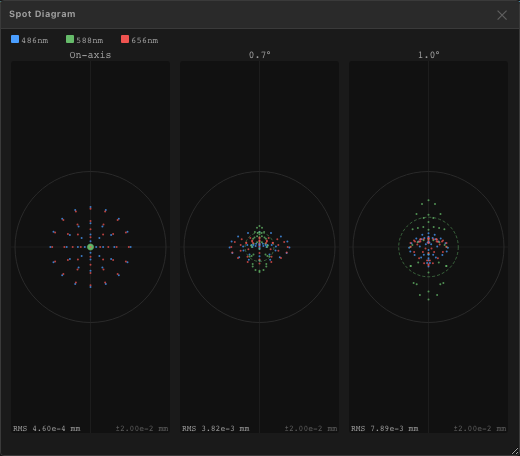
An apochromatic triplet objective optimised for astroimaging. Three elements in air allow independent control of primary and secondary colour, producing a flat, well-corrected field across a 2° full angle at f/2.8. N-BK7 and SF1 are used to balance chromatic aberration without exotic glass.


Opens directly in Trefoila.
Requires an active license.